
Sending Money to Australia: How to Transfer Funds
Whether you're moving your life savings ahead of a relocation, paying a deposit on an Australian rental, settling a property purchase, or supporting family, transferring money to Australia is one of the first practical tasks most people face. Getting the beneficiary's account details and the transfer method right — and understanding the foreign exchange (FX) behind the scenes — saves you time, stress and money.
Quick answer
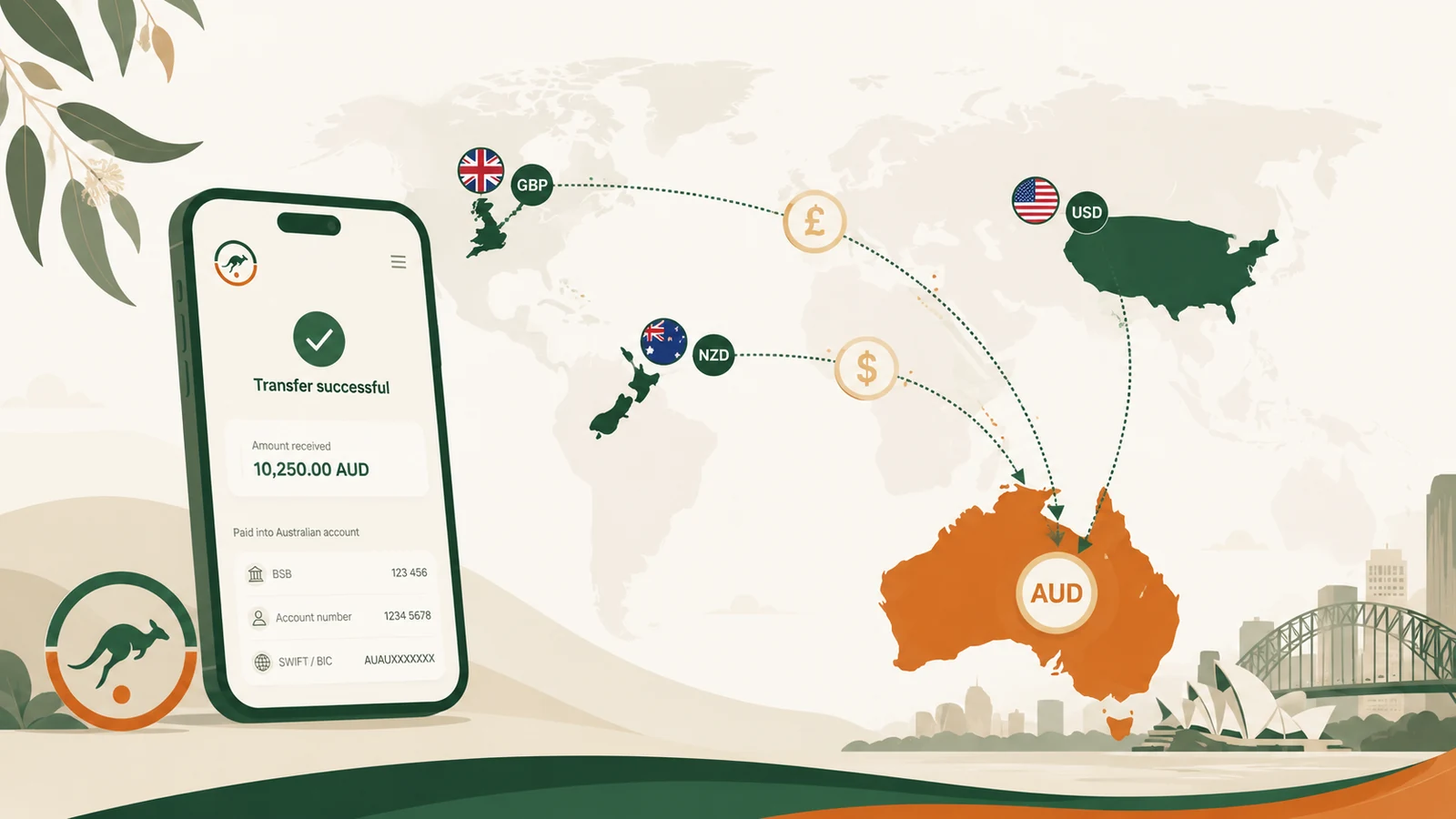
To send money to Australia you need the recipient's account name, their six-digit BSB (Bank State Branch) code and account number, and — for an international transfer — the receiving bank's SWIFT/BIC code, since Australia does not use IBANs. You can remit funds through your bank as a telegraphic (wire) transfer or through a specialist money-transfer provider, and the route you choose affects both the exchange rate and the fees you pay.
Live exchange rates to Australian dollars
European Central Bank reference rates
Mid-market (interbank) rates shown for reference only, sourced from the European Central Bank via Frankfurter. The rate a provider offers you will differ by their exchange-rate margin — always compare the total AUD you will actually receive before you send.
Our preferred money-transfer partner
The rate above is the mid-market rate. Your bank won't give you it.
Currencies Direct charges no transfer fees and lets you lock a rate before you move. FCA-authorised, and free to open an account.
How do you send money to Australia?
You send money to Australia by making a cross-border international transfer from your home bank account, or through a licensed money-transfer specialist, into the beneficiary's Australian bank account. Bank-to-bank payments travel over the SWIFT network — often as a telegraphic transfer routed through one or more correspondent (intermediary) banks — and the sending institution converts your currency into Australian dollars (AUD) before the funds settle in the destination account.
The process is broadly the same wherever you're sending from — the UK, New Zealand, the United States, India, Canada or elsewhere. What differs is the currency corridor (for example GBP/AUD or NZD/AUD), the exchange rate you're offered against the mid-market (interbank) rate, and how each provider structures its fees. Because Australia does not use the IBAN system common across Europe, you'll be asked for a BSB code and a SWIFT/BIC code instead.
What details do you need to send money to an Australian bank account?
Before you initiate a transfer, collect the beneficiary's banking details in full. A single mistyped digit can delay a payment, trigger a manual repair fee, or misdirect the funds, so confirm each detail directly with the recipient rather than relying on memory.
- Account holder's (beneficiary's) full name, exactly as it appears on their Australian account
- BSB number — the six-digit Bank State Branch code that identifies the financial institution and branch
- Account number — usually six to ten digits
- SWIFT/BIC code — the bank identifier code required for any inbound transfer arriving from overseas
- The recipient's bank name and, for some telegraphic transfers, the branch address
- A payment reference or description so the recipient can reconcile the deposit
- PayID (an email, phone number or ABN) if you're paying someone already inside Australia via Osko on the New Payments Platform
What are the main ways to transfer money to Australia?
There is no single best option for everyone — the right choice depends on how much you're sending, how quickly you need it to arrive, and how much value you place on convenience versus cost. The four routes below cover almost every situation.
- High-street and international banks — convenient telegraphic (wire) transfers if you already bank with them, but often the widest exchange-rate spread
- Specialist money-transfer providers and foreign-exchange (FX) brokers — usually sharper exchange rates and clearer fees, and well suited to larger relocation transfers
- Online remittance apps and fintechs — fast, low-friction transfers for smaller, everyday amounts sent from a phone
- Multi-currency (borderless) accounts — let you hold AUD and convert at a rate that suits you, useful if you transfer regularly or earn in more than one currency
| Transfer method | Typical speed | Exchange-rate spread | Rate-protection tools | Best suited to |
|---|---|---|---|---|
| High-street bank (telegraphic transfer) | 1–3 business days | Usually the widest | Rarely offered | Convenience when you already bank there |
| Specialist FX broker | Same day – 2 business days | Usually the narrowest | Forward contracts, limit orders, dedicated dealer | Large relocation-sized transfers |
| Online remittance app | Minutes – 1 business day | Narrow on small amounts | Rate alerts only | Small, everyday transfers from a phone |
| Multi-currency account | Instant between own balances | Narrow, converted when you choose | Hold and convert at your own timing | Regular transfers or multi-currency earners |
How much does it cost to send money to Australia?
The cost of sending money to Australia has two components: the upfront transfer fee, and the exchange-rate margin — the spread a provider adds on top of the mid-market (interbank) rate you see on Google or Reuters. This margin is the part most people overlook, and because it is baked into the exchange rate rather than shown as a line item, on a large transfer it can dwarf any flat fee.
Because the foreign-exchange market moves second by second and every provider prices its spread differently, we don't publish indicative rates or fees — they would be out of date the moment they were written. Instead, always compare the total amount of AUD the beneficiary will actually receive across two or three providers at the moment you're ready to send. That single net figure captures both the fee and the exchange-rate margin, and it's the only like-for-like way to compare.
- Compare the final AUD received (the net amount), not just the advertised fee
- Watch for a marked-up exchange rate hidden behind a 'zero fee' or 'commission-free' offer
- Ask whether correspondent, intermediary or receiving-bank charges may be deducted from the funds in transit
- For large one-off transfers, locking in a rate protects you from adverse currency movements between agreeing and sending
How can you protect a large transfer from exchange-rate swings?
When you're moving a life-changing sum — the proceeds of a house sale, your pension, or savings to buy property in Australia — a small shift in the exchange rate between agreeing your move and sending the money can cost or save you thousands. This is where specialist money-transfer providers offer tools that high-street banks and simple remittance apps usually do not.
These currency risk tools are the single biggest reason relocators choose a dedicated FX provider over their bank. They let you take control of the rate rather than being at the mercy of the market on transfer day.
- Forward contract — lock in today's exchange rate for a transfer up to around 12 months in the future, so you know exactly how many Australian dollars you'll receive regardless of market moves
- Limit order — set a target rate and have your transfer execute automatically if the market reaches it
- Stop-loss order — set a floor rate to protect against the market falling below a level you can't afford
- Regular payment plan — automate recurring transfers (useful for mortgage payments, tuition, or supporting family) at a consistent rate
- A dedicated dealer — a named account manager who can talk you through timing on a large relocation transfer, rather than a call-centre queue
How long does a transfer to Australia take?
Most international transfers to Australia arrive within one to three business days once the payment is funded and any compliance and verification checks are complete, though a same-currency or SWIFT gpi-tracked payment can settle sooner while an exotic corridor routed through several correspondent banks may take a little longer. The value date — the day the funds clear into the account — depends on cut-off times and the banks involved at each end.
Once money is already inside Australia, domestic payments between accounts via Osko and PayID on the New Payments Platform (NPP) are typically near-instant, day or night, while older batch-processed BECS transfers can take a business day. Cut-off times, weekends and public holidays in either country can add delay, so allow extra time if you're settling a time-sensitive bill such as a rental bond or property deposit.
Is sending money to Australia safe and regulated?
Yes — Australia has a well-established regulatory framework for money transfers. Any business that provides remittance or money-transfer services must be enrolled on the remittance sector register maintained by AUSTRAC, the Australian Transaction Reports and Analysis Centre, which oversees anti-money-laundering and counter-terrorism-financing (AML/CTF) compliance. Providers offering financial products generally also hold an Australian Financial Services Licence (AFSL) regulated by ASIC, the Australian Securities and Investments Commission.
To protect yourself, choose a provider that is clearly authorised both in Australia and in the jurisdiction you're sending from — for example the Financial Conduct Authority (FCA) in the UK, the Financial Markets Authority (FMA) in New Zealand, FinCEN in the United States, or FINTRAC in Canada. Reputable firms safeguard client money in segregated accounts and are transparent about their fees, exchange-rate spread and the licence they hold.
Sending money to Australia from different countries
The country you're sending from shapes the currency corridor, the typical delivery speed and the providers available to you. The New Zealand to Australia (NZD/AUD) corridor is one of the busiest in the world, thanks to the Trans-Tasman relationship and the freedom of movement many residents enjoy under the Special Category Visa.
Wherever you're sending from, the fundamentals don't change: gather the beneficiary's BSB, account number and SWIFT/BIC code, compare the net AUD received across a couple of providers, and confirm both ends are dealing with a regulated, AUSTRAC-registered business. If you're remitting a large sum as part of a relocation, it's worth speaking to a specialist dealer who can talk you through timing, corridors and rate-protection options.
- From New Zealand — a high-volume NZD/AUD corridor with fast, competitive Trans-Tasman transfers
- From the UK — GBP/AUD is a mature corridor with many FCA-authorised providers to compare
- From the USA and Canada — USD/AUD and CAD/AUD transfers are widely supported by banks and FinCEN- and FINTRAC-registered specialists
- From India — INR/AUD is a popular corridor; outward remittances are governed by the Reserve Bank of India's Liberalised Remittance Scheme (LRS)

Our preferred money-transfer partner
Why we recommend Currencies Direct
Having helped people relocate to Australia for years, our preferred partner for larger transfers is Currencies Direct. Established in 1996 and authorised by the UK's Financial Conduct Authority, they specialise in exactly the kind of relocation transfers our clients make — with the rate-protection tools banks rarely offer and no transfer fees.
- No transfer fees and bank-beating exchange rates on relocation-sized transfers
- Forward contracts and rate alerts to lock in your rate before you move
- A dedicated, named currency dealer for larger transfers
- FCA-authorised in the UK, with client funds held in segregated accounts
- Award-winning service with a long track record on the UK, NZ and Australia corridors
We may receive a commission if you open an account through this link, at no extra cost to you. We only recommend Currencies Direct because we have found them to be a genuinely strong option for relocation transfers — you should always compare the total AUD you'll receive before choosing any provider.
Sources & further reading
- ASIC MoneySmart — Managing money and international transfers
- AUSTRAC — International funds transfer instructions (IFTIs)
- Reserve Bank of Australia — Fast payments (Osko & PayID)
Figures are indicative and were last reviewed on 1 July 2026. Always confirm current fees and requirements with the relevant official authority before acting.
Frequently asked questions
What is the cheapest way to send money to Australia?
There's no single cheapest provider — it changes with the amount, the currency and the day. The reliable way to find the best value is to compare the total Australian dollars the recipient will receive across two or three regulated providers, since that figure reflects both the fee and the exchange-rate margin.
What is a BSB number?
A BSB (Bank State Branch) number is a six-digit code that identifies the specific financial institution and branch of an Australian account. You'll need it alongside the account number to send money to Australia. For an inbound transfer arriving from overseas, you also need the bank's SWIFT/BIC (bank identifier) code, as Australia does not use IBANs.
Can I send money to Australia using PayID?
PayID and Osko run on Australia's New Payments Platform (NPP) for near-instant payments between accounts that are already within Australia, not for cross-border transfers arriving from another country. To send money internationally you use a bank telegraphic transfer or a specialist provider, quoting the BSB, account number and SWIFT/BIC code.
How do I send money to Australia from New Zealand?
Sending money from New Zealand to Australia works like any international transfer: you convert NZD to AUD through a bank or a licensed money-transfer specialist, using the recipient's BSB, account number and SWIFT/BIC code. It's a busy corridor, so compare the final AUD received across a few providers.
Do large transfers to Australia need to be reported?
Providers must report international funds transfers to AUSTRAC, and cash transactions of AUD 10,000 or more are separately reportable. This is a compliance requirement handled by the business, not a fee — but you should expect identity checks, especially on larger transfers.
Is it better to use a bank or a money-transfer specialist?
Banks are convenient if you already hold an account with them, but specialists often offer sharper exchange rates and clearer fees, which can make a meaningful difference on a large relocation transfer. Compare the total AUD received from both before deciding.
Can I lock in an exchange rate before I move to Australia?
Yes. A forward contract lets you fix today's exchange rate for a transfer up to around 12 months ahead, so a falling market won't reduce the Australian dollars you receive. This tool is offered by specialist providers such as our preferred partner Currencies Direct, rather than by most high-street banks.
Which money-transfer provider do you recommend for moving to Australia?
For larger relocation transfers we recommend Currencies Direct — an FCA-authorised specialist established in 1996 that offers no transfer fees, competitive rates, forward contracts to lock in your rate, and a dedicated dealer. As with any provider, compare the total AUD you'll receive before you commit.
Related guides
Chosen because they cover the next decision after this one. For everything else, see all moving to Australia guides.
Planning your move to Australia?
Get a free, no-obligation shipping quote for your relocation.
