
Moving Pets to Australia
Bringing your dog or cat to Australia is one of the most regulated pet imports in the world. The process involves DAFF biosecurity permits, mandatory quarantine at Mickleham, RNAT blood testing, and approved-airline-only flights. We manage every step.
Start planning at least 6–12 months before your move
The Rabies Neutralising Antibody Titre (RNAT) test result must be at least 180 days old at the time of your pet's arrival in Australia. This single requirement sets the minimum timeline for most countries. Quarantine facility slots at Mickleham are limited — early booking is essential.
Why Is It So Complex to Bring a Pet to Australia?
Australia is one of very few countries in the world that remains free of rabies. Maintaining that status requires the Department of Agriculture, Fisheries and Forestry (DAFF) to operate some of the most thorough animal import protocols anywhere. All imported cats and dogs — regardless of origin — must complete mandatory quarantine at the government's Post Entry Quarantine (PEQ) facility in Mickleham, Victoria.
Unlike some countries that allow home quarantine, Australia's Mickleham facility is the only approved location. Your pet will be cared for there by trained staff regardless of which Australian city is your destination. This is non-negotiable.
The complexity of the process makes professional coordination essential. A missed vaccination window, incorrect laboratory, or late BICON permit application can mean your pet cannot travel — sometimes requiring a full restart of the process.
Mickleham, VIC
Only approved quarantine facility in Australia
180-Day RNAT Rule
Blood test result must be 180 days old at arrival
BICON Permit
DAFF biosecurity import permit required before travel
6–12 Months
Minimum planning horizon for most countries
What Country Group Is Your Pet Coming From?
Australia categorises origin countries into groups based on rabies risk. Your group determines the quarantine period, testing requirements, and preparation timeline.
| Group | Quarantine at Mickleham | RNAT blood test | Plan ahead |
|---|---|---|---|
| Group 1 — No quarantine | None | Not required | Weeks |
| Group 2 — Rabies-free countries | 10 days minimum | Check BICON — varies by country | About 6 months |
| Group 3 — Approved rabies-controlled countries | 10 days minimum | Required, sample at least 180 days before arrival | 12 months minimum |
No post-entry quarantine, and no rabies vaccination or RNAT testing required. This is the only group exempt from the Mickleham stay, which makes a trans-Tasman pet move far simpler than any other route.
Minimum 10 days at Mickleham. Requirements are lighter than Group 3 because these countries are recognised as free from rabies — confirm whether RNAT testing applies to your specific country in BICON.
The route most of our clients use. Rabies vaccination plus an RNAT blood test are required, and the RNAT sample must be taken at least 180 days before arrival — which is why pet planning starts long before the shipment does.
Country group lists are maintained by DAFF and can change. Always verify your country's current group and requirements through the BICON system before making any bookings or beginning veterinary preparations.
The 8-Step Pet Relocation Process
Each step must be completed in sequence and within specific time windows. Missing a window means restarting from that step.
Eligibility & Country Group Assessment
As early as possible — ideally 12 months before travelAustralia groups countries by rabies risk (Groups 1, 2, and 3). Your country of origin determines quarantine length, testing requirements, and preparation timeline. We confirm your pet's eligibility and map out the exact requirements before you book anything.
Microchipping
Before vaccinations — at least 6–12 months before travelYour pet must be implanted with an ISO 11784 / ISO 11785 compliant microchip (15-digit, 134.2 kHz) before any vaccinations relevant to import are administered. The microchip number must be recorded on all health documents.
Vaccinations and RNAT Blood Test
6–12 months before travel (RNAT result must be at least 180 days old)A current rabies vaccination is required. For most Group 3 countries (including the USA, Canada, and EU), a Rabies Neutralising Antibody Titre (RNAT) test must be performed by an approved laboratory no less than 180 days before departure. Internal and external parasite treatment must be applied within the required window before travel.
BICON Import Permit
Apply at least 6 months before travelA biosecurity import permit must be applied for through BICON (Biosecurity Import Conditions system), managed by the Department of Agriculture, Fisheries and Forestry (DAFF). The permit specifies the exact conditions your pet must meet. We prepare and submit this application on your behalf.
Quarantine Facility Booking — Mickleham
Book as soon as import permit is grantedCats and dogs arriving from Group 2 and Group 3 countries must complete quarantine at the Australian Government's Post Entry Quarantine facility in Mickleham, Victoria — a minimum of 10 days. Pets from Group 1 countries (New Zealand, Norfolk Island and the Cocos Islands) are exempt. Availability at Mickleham is limited and bookings are essential; we secure your slot as part of our service.
Approved Airline and IATA-Compliant Crate
Confirm airline 2–3 months before travelOnly approved airlines can carry animals to Australia. Your pet must travel in an IATA-compliant crate sized appropriately for the animal. We coordinate with approved carriers and ensure crate compliance.
Health Certificate from Approved Vet
10 days before departureA government-endorsed health certificate must be issued by an accredited veterinarian within 10 days of travel (exact window varies by country). The certificate must confirm all conditions of the import permit have been met.
Quarantine & Home Delivery
10–30 days quarantine after arrivalUnless your pet is arriving from a Group 1 country, it is transported to the Mickleham facility on arrival and held for a minimum of 10 days. After clearance, we arrange collection and door delivery to your Australian address.
Moving to Australia With a Dog or Cat: the Core Requirements
These are the baseline requirements for all cats and dogs entering Australia. Additional requirements apply based on your country group.
- ISO 11784/11785 compliant microchip
- Current rabies vaccination (after microchip)
- RNAT blood test from approved laboratory (Group 3 countries)
- Internal parasite treatment (tapeworm) within required window
- External parasite treatment within required window
- Health certificate from accredited government vet
- BICON import permit from DAFF
- Quarantine booking at Mickleham, Victoria
- Snakes and reptiles (most species)
- Rabbits (prohibited in most states)
- Hamsters and gerbils
- Certain bird species without specific permits
- Animals from countries not on Australia's approved list
Moving Pets to Australia — FAQs
How early do I need to start planning my pet's relocation to Australia?
A minimum of 12 months for Group 3 countries, which is where the United Kingdom, Ireland, the USA mainland, Canada and most of the EU sit. Around 6 months is workable for Group 2 rabies-free countries such as Japan and Singapore, and a move from New Zealand (Group 1) needs far less. The RNAT blood test result must be at least 180 days old at the time of arrival in Australia — that single requirement drives the timeline for most countries. Quarantine facility bookings at Mickleham are also limited, so securing your slot early is essential.
Where do all pets entering Australia go for quarantine?
All imported cats and dogs must complete mandatory quarantine at the Australian Government Post Entry Quarantine (PEQ) facility in Mickleham, Victoria — regardless of which Australian city you are moving to. There is only one approved facility. The minimum period is 10 days for most countries. After release, we arrange transport to your home.
What is the BICON system and why do I need it?
BICON (Biosecurity Import Conditions) is the Australian government's online database of import conditions managed by DAFF. You must apply through BICON to receive a biosecurity import permit before your pet can travel to Australia. The permit lists the specific conditions your pet must meet — vaccinations, testing, treatment windows, approved airlines, and health certificate requirements. Without a permit, your pet cannot enter the country.
Can I bring any breed of dog to Australia?
Most breeds are permitted, but Australia's Customs (Prohibited Imports) Regulations 1956 prohibit the importation of several breeds considered dangerous: American Pit Bull Terrier (and related types), Japanese Tosa, Dogo Argentino, Fila Brasileiro, and Perro de Presa Canario. Check with DAFF's BICON system before making any arrangements if you have concerns about your breed.
What is the RNAT test and which countries require it?
The Rabies Neutralising Antibody Titre (RNAT) test — sometimes called a rabies titre test — measures the level of rabies antibodies in your pet's blood to confirm the vaccination is effective. It must be performed by an approved laboratory, and the result must be at least 0.5 IU/mL. For Group 3 countries (USA, Canada, most EU countries, South Africa, UAE), the test result must be at least 180 days old at the time of arrival in Australia. This 180-day waiting period is the main driver of the 12-month planning requirement.
How much does pet relocation to Australia cost?
Total costs vary significantly depending on your country of origin, your pet's size, and the complexity of requirements. Cost components include: the BICON permit fee (a government fee), approved vet health certificate fees, an IATA-compliant crate, airfreight (typically the largest single cost), quarantine facility fees at Mickleham, and our coordination service fee. We provide a detailed, itemised quote specific to your pet and origin country.
Can I visit my pet during quarantine at Mickleham?
Yes. The Mickleham facility offers scheduled visitation sessions for owners. DAFF provides details of visiting hours after your booking is confirmed. Your pet is cared for by trained staff during the entire quarantine period.
What animals other than cats and dogs can I bring to Australia?
Australia has strict rules on importing animals beyond cats and dogs. Many common household pets — including rabbits (prohibited in most states as they are a declared pest), hamsters, gerbils, and most reptiles — cannot be imported at all. Birds require separate permits and lengthy quarantine. We specialise in dogs and cats; for other animals, we recommend contacting DAFF directly via BICON.
Our pet relocation partner
We arrange household removals, not pet transport. For the animal side of the move we refer people to Starwood Pet Travel, who handle the IATA paperwork, the crate requirements and the door-to-door logistics that sit alongside your BICON import permit.
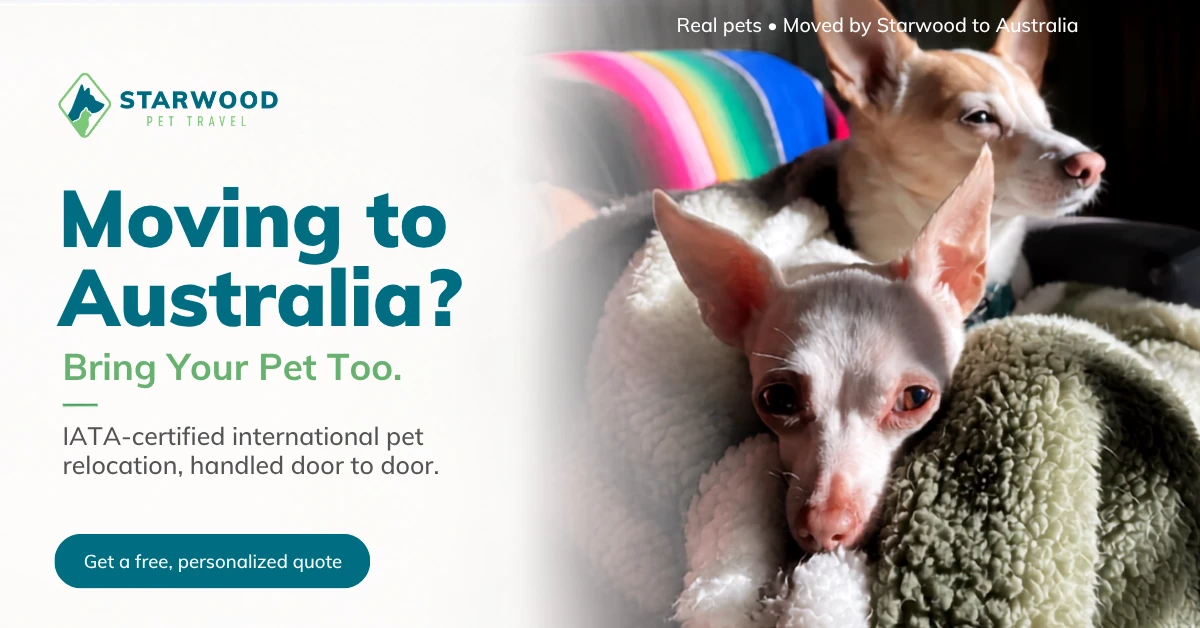
Starwood Pet Travel is an independent company and its IATA certification is its own — we hold no pet-transport accreditation. We may receive a commission if you request a quote through this link, at no extra cost to you. Compare it against other pet relocation specialists before you commit; the cheapest quote is rarely the one that has read the DAFF conditions for your country group.
Related Guides
Customs & Quarantine Guide
DAFF biosecurity rules, B534 form, prohibited items, and ABF requirements for household effects.
International Shipping Options
Sea freight and air freight options, timelines, and container sizes for your household removal.
All Removals Services
Full overview of our international removals services including vehicles, customs, and shipping.
Start Planning Your Pet's Move to Australia
The sooner you start, the smoother the process. Our specialists assess your pet's country group, create a personalised timeline, and manage every step from BICON permit to home delivery.
